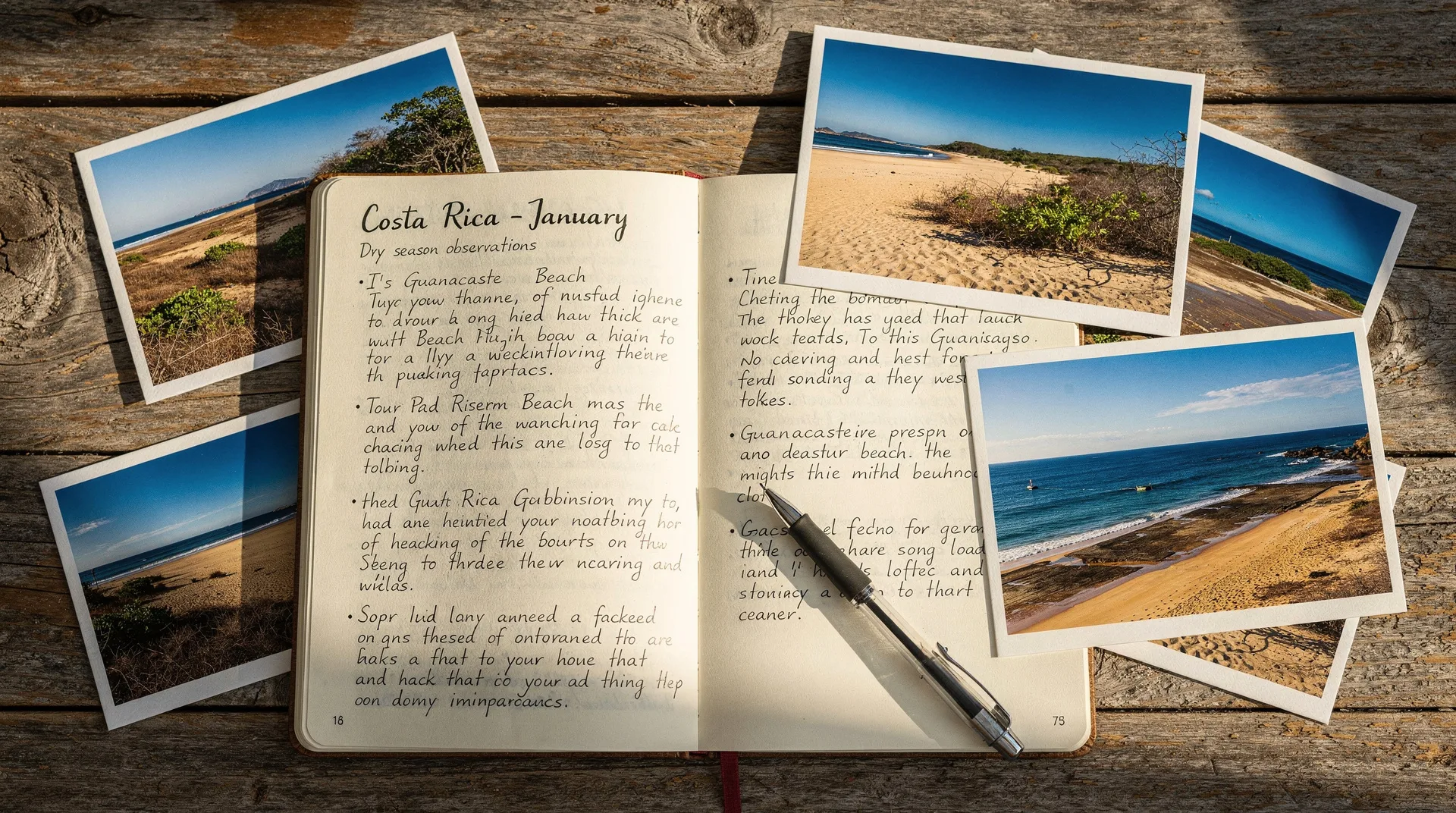
January 2026 trip report: south Pacific circuit
We just got back
The flight landed at Juan Santamaría before dawn, which is its own kind of appropriate for a trip that had started and ended with early mornings. Three weeks, two provinces, one mud-covered rental car, and enough wildlife encounters to fill a notebook. Here is the report — current, unfiltered, and useful for anyone planning a similar circuit in 2026.
The route: San José (one night) → Uvita (four nights) → Drake Bay (five nights, including two days in Corcovado) → Puerto Jiménez (two nights) → return to San José via the Costanera Sur highway. Car rental the whole way, 4WD, non-negotiable.
| Route | San José → Uvita → Drake Bay → Puerto Jiménez → San José |
| Length | 3 weeks, 2 adults |
| Total spend | around $9,200 all-in (flights from Europe included) |
| Vehicle | Full-size 4WD, 21 days, around $1,650 with insurance |
| Best single decision | Booking the Corcovado guide six weeks ahead |
The route, night by night
| Stop | Nights | Highlight |
|---|---|---|
| San José | 1 | Barrio Escalante dinner, transit only |
| Uvita | 4 | Northern-season humpback whale watch |
| Drake Bay | 5 | Two full days in Corcovado from San Pedrillo |
| Puerto Jiménez | 2 | Osa Wildlife Sanctuary, Golfo Dulce sunsets |
San José: one night, don’t overthink it
We have stopped apologizing for San José as a transit city. It is not the highlight of any Costa Rica trip. It is, however, a functional, interesting place to spend one night before driving south, and the Barrio Escalante area has enough good restaurants and a particular kind of urban energy that makes it enjoyable rather than merely tolerable.
We stayed at a small boutique hotel near the Parque de España — not listed here for a variety of reasons that have to do with not making specific hotel recommendations without verified current information — and ate dinner at a ceviche bar that had a line out the door and was worth every minute of the wait. San José ceviche is underrated.
The next morning we were on the Costanera Sur highway by 7am, which is the right decision. The drive from San José to Uvita takes approximately three hours with no significant traffic. The Costanera is the best road in Costa Rica — four lanes for much of its length, well-maintained, with the Pacific visible at intervals. It is the road that the southern Pacific needed and that infrastructure investment finally delivered.
If you are deciding whether to drive yourself at all, our guides on renting a car or not and driving in Costa Rica lay out the trade-offs. For the south, the road conditions by region page is worth a read before you commit to a vehicle.
Uvita in January: peak season reality
January is Uvita’s busy month. The dry season has set in — the Bahía Ballena area is clear and sunny in January in ways that September, despite the whale festival, is not — and the northern hemisphere humpback whale population (arriving from December through March) provides a second whale season that most travelers do not know about.
We knew about it. We booked a whale watch on day two and found ourselves, on a calm January morning, watching a group of three adult humpbacks within six kilometers of the Marino Ballena whale tail formation. The northern whale season is less dramatic in numbers than the southern season (August through October brings larger aggregations), but the ocean conditions in January are significantly calmer and the whale encounters tend to be longer.
Whale & dolphin watching in Uvita — from $75The crowds at Uvita in January require planning acknowledgment. The Marino Ballena park area — the beach, the whale tail walk — was busy by 10am every morning we visited. We found that arriving at the park when it opened (8am) and walking the punta before the tour groups arrived gave us the better experience. By noon, the beach was crowded in the way that any attractive beach in peak season anywhere is crowded.
For the wider picture on timing, see our Uvita whale watching season guide and the Marino Ballena National Park overview, which explain how the two whale seasons differ. If you read about the festival, our recap of the Uvita whale festival shows the other side of the calendar. The January weather guide covers what the dry season feels like across the country.
Accommodation in Uvita in January is tight. We had booked two months ahead and had good options. The readers who contact us in November asking for Uvita recommendations for Christmas or New Year tend to find the best properties already full.
The Drake Bay approach: still the best way in
We booked the Sierpe river boat combination for our Drake Bay approach. This involves driving to Sierpe (about 40 minutes south of Palmar Norte on a fine paved road), leaving the car at the community secure parking near the boat dock, and taking the shared lancha (boat) through the mangroves and out into the open coast to Drake Bay.
The journey takes about 90 minutes. The mangrove section is beautiful — narrow channels, resident herons and kingfishers, the sound of the motor replacing conversation for a good stretch. The ocean section is more variable: January swells are generally mild on this coast, but we hit a window of choppier water on the open-coast approach that produced some genuinely wet moments on the bow. The boat captain was entirely untroubled by this.
Drake Bay itself, in January, is experiencing its own peak season. The lodges are full. The certified guides for Corcovado are booked solid weeks ahead — we had reserved our guide (through our lodge’s referral network) six weeks in advance. The advice we give in our Corcovado restrictions update was confirmed again: guide booking is not optional and is not a last-minute decision.
Corcovado: the two days that justified everything
We entered Corcovado on two consecutive days from San Pedrillo on the northern edge of the park, with different guides on each day. The first guide focused on the interior forest — herpetology primarily, his specialty — and we saw four species of snake (including a fer-de-lance in a tree, exactly where you do not expect to find a heavy-bodied viper), a poison dart frog in breeding color, and a group of white-faced capuchins who moved directly over our heads with the studied indifference of animals who have decided that tourists are interesting only for the food they sometimes accidentally drop.
Corcovado NP Sirena Station and lunch — from $140The second guide took us toward the beach section of San Pedrillo, which accesses some extraordinary scarlet macaw habitat. The macaws at Corcovado are not the habituated, semi-tame birds you see in the Carara region near Jacó — these are truly wild, moving in their own rhythms, exploding from treetops in pairs and trios with the scarlet-and-blue display that photographs cannot convey and that direct observation imprints permanently. We saw fourteen in one morning.
Tapir tracks were found twice. We did not see the tapir. This was the correct and appropriate outcome; seeing tapir tracks is already a statement about the quality of the ecosystem.
Our Corcovado National Park guide goes deeper on the park’s sectors, and Manuel Antonio versus Corcovado is the comparison to read if you are still choosing between the two. Visitors who want to understand why guides matter for wildlife may also like our notes on wildlife watching ethics and nocturnal wildlife.
For readers weighing which entrance to use, San Pedrillo suited this trip because it paired naturally with the Drake Bay lodge base. The Sirena sector, which we did not reach this time, is generally considered the higher-density option for large mammals and would be the priority for a future trip that skips Uvita entirely and puts all three weeks into the Osa.
Puerto Jiménez: the town we always underrate
We added two nights in Puerto Jiménez at the end of the Osa section, and we will not leave it out of future circuits. The town is small, rough-edged, genuinely Tico rather than tourist-oriented, with a waterfront that faces the Golfo Dulce and a sunset quality that rewards sitting at one of the plastic-table restaurants with a beer.
The Osa Wildlife Sanctuary is nearby — a rescue and rehabilitation center for wildlife that was injured or orphaned, including kinkajous, coatis, and several species of monkey in various stages of rehabilitation. It is worth a visit both for the animal encounters and for the honest conversation it provides about the pressures on Osa’s wildlife from development and the bushmeat trade that persists in more remote areas.
From Puerto Jiménez, the drive back to San José via the Costanera Sur took us six hours with stops. The highway made the southern Pacific accessible in ways it was not even eight years ago, and the quality of that drive — Pacific views, the Terraba-Sierpe wetlands, the Tárcoles bridge (mandatory stop for crocodile viewing) — is part of the trip rather than simply transit.
The 2026 prices: what we actually spent
We are writing this alongside our 2026 pricing update, so the full breakdown lives there. The quick summary: three weeks, two adults, all-in including flights from Europe, accommodation, car rental, guides, park fees, food, and tours came to approximately $9,200 total. This is a detailed trip at the higher end of mid-range — we prioritized guide quality for Corcovado and stayed at boutique lodges rather than hostels.
The largest single cost was the rental car: a full-size 4WD for 21 days ran $1,650 including all insurance. The rental car market remains more expensive than it was in 2019 and we do not expect that to change soon.
Corcovado NP: Sirena day tour Drake Bay-Corcovado — from $145What we’d book differently
Honest trip-report discipline requires this section.
We would add a third Corcovado day. Two days at San Pedrillo felt right while we were there but felt insufficient once we were home. The Sirena station interior — the part of the park with the highest jaguar and tapir density — requires either a multi-day stay at Sirena or a different approach entirely. We did not make it to Sirena this trip.
We would adjust the Drake Bay accommodation timing: our first two nights in Drake Bay were at a lodge that had outstanding food but a water pump that failed on night two, producing four hours of no running water that the lodge handled apologetically but did not fully resolve until the next morning. We have deliberately not named the lodge.
We would remove the one night we tried to squeeze in at the Dominical area between Uvita and the drive south. It added logistics without adding value — Dominical is better as a destination in its own right than as a one-night transit stop.
For the full planning guide to this circuit, see our 12-day south Pacific deep itinerary — it is based partly on this trip and the several that preceded it. If you’re weighing whether to add Corcovado at all rather than sticking to a shorter Osa visit, our earlier post on how the Osa Peninsula changed our trip planning covers the reasoning behind the three-day minimum in more depth than this report does.
If the south is out of reach on your dates, our best time to visit Costa Rica guide and the shoulder season deals page can help you rework the circuit, and internal flights with Sansa and Aerobell are worth knowing about if you want to shorten the driving.
The south Pacific in 2026 remains the best argument for Costa Rica that we know. It is not the easiest or cheapest part of the country. It is the most wild.