Reopening borders: what changed in 2021
The trip we kept postponing finally happened
We had been waiting to return to Costa Rica since March 2020. Like most travelers who had been mid-trip when the borders closed, we had spent the intervening year and a half watching the ICT’s communications with a mix of hope and frustration, rescheduling flights twice, and eventually booking a late-2021 departure on the assumption that something had to give.
Something did. By the time we arrived in October 2021, Costa Rica had been nominally open to vaccinated international travelers for several months. But “open” meant something more complicated than the usual process of booking a flight and showing up with a passport. The 2021 rules were a system in motion — changing faster than guidebooks could track — and what we encountered on arrival was different enough from pre-pandemic entry that it warranted a proper account.
| Period covered | July 2020–2021 reopening; what stuck through 2026 |
| Entry then | Digital health pass + vaccination proof |
| Entry now | See our visa and entry requirements guide |
| What stayed | National park reservation systems (Manuel Antonio, Poás) |
| Historical value | Context for why park bookings and digital forms exist |
The phased reopening: how it actually worked
Costa Rica began allowing vaccinated international travelers in July 2020, initially only from a list of low-risk countries. By late 2020, the approved country list had expanded significantly. By August 2021, the vaccination requirement had been formalized: travelers needed to show proof of full vaccination to enter without purchasing mandatory travel insurance through the government portal.
That last point matters. The ICT introduced a travel insurance requirement in 2020 that applied to unvaccinated visitors — a policy that was both a public health measure and, frankly, a way to ensure that tourist-related hospitalizations would not fall on the public health system. For vaccinated travelers, this requirement was lifted in August 2021, though the government still strongly encouraged voluntary travel insurance coverage.
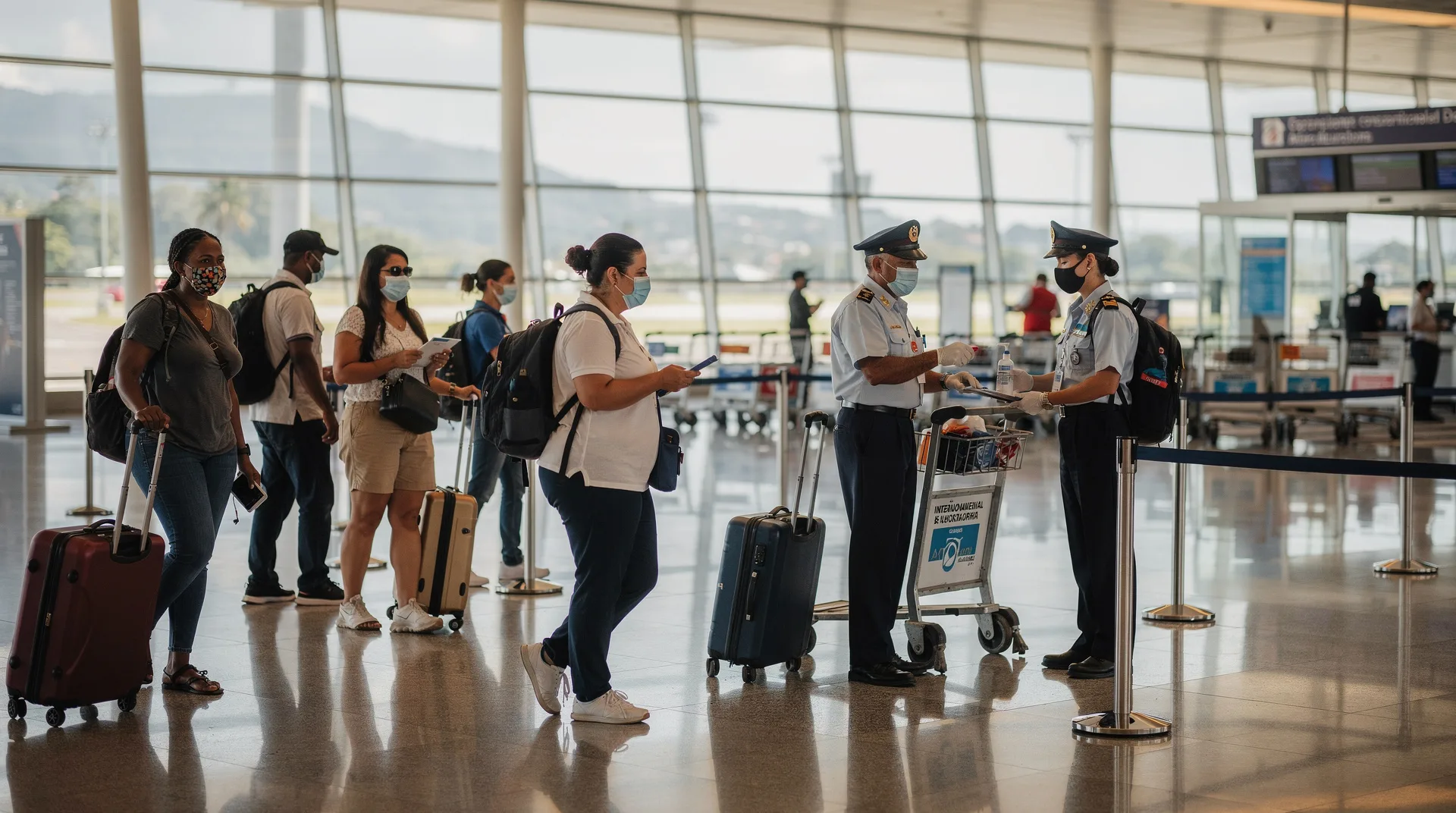
The practical entry process in October 2021, when we flew in, worked as follows: digital health form completed online before departure (the health pass portal), vaccination certificate uploaded and validated, then a standard passport control queue that moved faster than the old process because the health declaration had been handled digitally.
What we had not expected was how functional the system actually felt. Our health pass had been validated within four hours of uploading it — we had prepared for a two-day wait based on forum reports from earlier in the summer. The immigration officers were clearly practiced, the queues moved, and we were in a taxi to San José within forty-five minutes of landing.
What the ICT actually changed on the ground
Beyond the entry formalities, the ICT had been working throughout 2020 and 2021 on what they called the “New Normality” protocols — operating standards for hotels, restaurants, tours, and transport that applied across the industry.
When we arrived in 2021, the visible effects were the expected ones: mask requirements in enclosed spaces, capacity limits in restaurants, hand sanitizer at every entrance. Less expected was how thoroughly the protocols had been integrated into tour operations. The certified operators running day trips to places like Manuel Antonio National Park or the Arenal area had adapted their group sizes, their vehicle arrangements, and their guiding patterns in ways that, honestly, made the tours better.
Smaller groups are better for wildlife watching. A van with eight people rather than fifteen means quieter movement on a trail, better individual attention from the guide, and a more honest claim to being a “nature experience” rather than a crowd management exercise. Several operators told us they intended to keep the reduced group sizes permanently, and some have.
Manuel Antonio Park: guided walking tour with a naturalist — from $65The national parks: reservation systems that stayed
One change from the 2020-2021 period that became permanent was the reservation requirement for several national parks. Manuel Antonio National Park had operated on a first-come, first-served basis for much of its history — a system that, in peak season, meant visitors queuing before dawn. The pandemic forced the park to implement an online reservation system, and the ICT kept it in place when visitor numbers recovered.
As of 2021, Manuel Antonio required advance booking. Volcán Poás had required reservations since a 2017 eruption, a rule that the pandemic made more visible to travelers who had not previously planned that far ahead. Rincón de la Vieja saw similar changes.
The effect on the experience was measurable. We visited Manuel Antonio in October 2021 at mid-morning on a Tuesday (the park closes Tuesdays — that was a research error we discovered at the gate and resolved with a Wednesday visit). The crowd level was noticeably lower than pre-pandemic visits, and the animals — monkeys, iguanas, sloths — were visible closer to the main trails.
For travelers planning now, the reservation requirement is not a burden; it is simply a booking step. Reserve four to six weeks ahead for peak season (December through April). Off-peak travel gives you more flexibility but still benefits from online reservation to guarantee entry.
Prices in 2021: not what we expected
We had expected Costa Rica to be cheaper in 2021. The logic seemed sound — reduced visitor numbers, operators hungry for business, hotels incentivized to offer deals. In some categories, this was true: we found mid-range hotels at prices roughly 15-20% below their 2019 levels, and several tour operators were running promotions.
In others, it was not true at all. Rental car prices were higher in 2021 than in any year we could remember, for the same reason they were higher globally: the pandemic had caused rental agencies to sell down their fleets in 2020, and the used car market had absorbed those vehicles at a speed that left the agencies short of inventory when demand recovered. A compact 4WD that had cost $40-50 per day in 2019 was running $80-100 in late 2021.
Fuel was also up. And the colón had moved against the dollar in ways that compressed the local purchasing power advantage for dollar-denominated travelers.
The honest summary: 2021 was not the bargain window some travelers had anticipated. Specific deals existed in the hotel sector, but the overall cost of a Costa Rica trip was not dramatically lower than 2019. By 2022 and 2023, prices had moved decisively in the opposite direction.
The currency dimension of this story is worth its own treatment — the colón’s later swings against the dollar affected the local-price side of every trip far more than the 2021 rental car spike did. We cover that separately in our post on why the colón fell against the dollar, which picks up roughly where this 2021 account leaves off.
What Ticos thought about the reopening
We had honest conversations with the people running the operations we visited — lodge owners, shuttle drivers, tour guides, soda proprietors — about how they had experienced the closure and the reopening.
The dominant feeling was not resentment but exhaustion. Many operators had spent 2020 and early 2021 in a state of suspended uncertainty: unable to work, uncertain about their properties, watching their carefully built businesses sit idle. The Bono Proteger government payments had helped, but the gap between what that covered and what running costs actually required had been managed through savings, family support, and in some cases borrowing.
The reopening felt, to most of them, like waking from a bad dream that had lasted too long. Business was not instantly back to normal — it takes time for traveler confidence to rebuild, for booking lead times to normalize, for group tours to reconstitute themselves. But the direction was right.
One guide we worked with in the Sarapiquí region put it well: “We were ready to work again. The hardest part was not knowing when ready would be enough.” By October 2021, ready was, mostly, enough.
Arenal: rafting Sarapiqui River day tour Class II-III — from $85What the reservation requirement means for the parks we mention here
Since this post’s original writing, the reservation habit born in 2020-2021 has spread beyond Manuel Antonio and Poás. Rincón de la Vieja National Park now runs on the same logic — book ahead, expect a quota, and treat the requirement as part of planning rather than a hurdle. If your itinerary includes the Arenal area, it is worth reading how that park’s rules compare in our Arenal vs. Rincón de la Vieja guide before you build a day-by-day plan.
What changed permanently
Looking back from 2026, the changes that stuck from the 2021 reopening period are worth noting for travelers planning now.
The national park reservation systems stayed. Most parks now require advance booking during high season, and several have formalized this into year-round requirements. This is good for the wildlife and, ultimately, good for the visitor experience.
The online health documentation habit built the infrastructure for Costa Rica’s digital border management more broadly. Entry forms are now submitted digitally as standard practice, and the processing infrastructure is more robust than it was in 2019.
Some operators who could not survive the closure did not reopen. The consolidation of the tour operator market in some areas means that the range of small, family-run options has narrowed in some destinations. This is worth knowing when you research — the operator who ran the tour you loved in 2018 may have a different name, a new ownership structure, or may no longer exist.
For current entry requirements and what the park reservation system looks like now, read our visa and entry requirements guide — it is kept more current than this post, which is now primarily a historical record of a specific and unusual moment.
The borders are open. The parks are running. The wildlife is there. That is more than we could say with certainty in October 2021, which is perhaps why the trip felt so good.